In 2026, search visibility will not depend on traditional SEO alone. Brands must master a three-layered discovery strategy, namely SEO, AEO, and GEO. Together, they define what’s called Search Everywhere Optimisation, which focuses on visibility across search, answers, and generation.
Search has long gone beyond the archaic concept of merely typing keywords into Google. It is now about being understood by machines that interpret meaning, intent, and trust. The seismic shift owes much to the unrelenting updates powered by new AI. Now, the current search trends have also affirmed that visibility will not be limited to ten blue links in 2026. It will span across search results, AI overviews, and generative summaries. Subsequently, the debate around SEO vs GEO vs AEO is pushing brands to rethink how to prepare themselves for the new discovery ecosystem. This has placed marketers at a crossroads with their visibility strategy. Because now they must optimise not only for search engines but also for answer engines and generative engines as well.
This blog will explore the debate further and identify the ideal strategy for brands in the coming years dominated by AI technology.
The ‘SEO Vs. GEO Vs. AEO’ Debate Continues to 2026 – The New Inflection Point
The year 2026 marks the convergence of AI in SEO, LLM-based retrieval systems, and new search behaviours. Platforms like ChatGPT Search, Perplexity, Gemini, and Google’s AI Overviews are now where users discover, evaluate, and even decide.
But….does the reality match the statement above?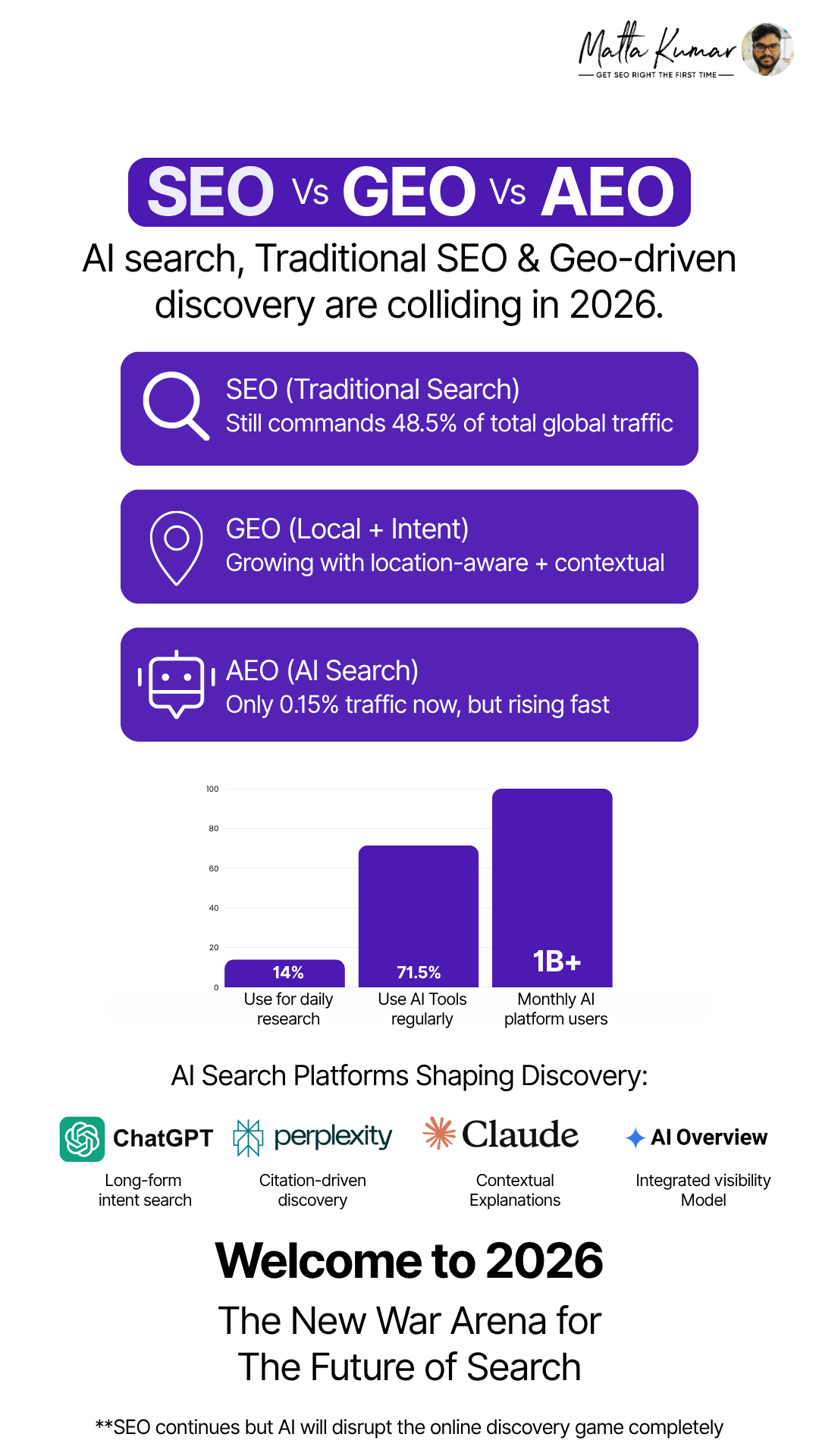
A recent report showed that the global search traffic from these AI Chatbots accounts for just 0.15%, whereas traffic from organic search amounted to 48.5%. Even though AI search traffic remained comparatively low, it has shown a significant upward spiral since 2024.
Hence, the year 2026 can expect a complete transformation of Internet search, as predicted by the 2024 report from Gartner. This study had earlier warned of a 25% drop in traditional search engine volume by 2026.
The chances of this prediction coming true in the next year are high because, as per two different reports, nearly 71.5% of Internet users are already leveraging AI tools, while 14% use them for their daily research, and over 1 billion people worldwide are already using standalone AI platforms every month.
Much of the credit goes to Internet users who no longer search but ask and expect answers.
So where does this debate stand? It is safe to say that the world is entering a new search time war, where AI tools like ChatGPT, Claude, Perplexity, and others are colliding headlong with Google over search dominance. Google still dominates traditional queries, but the others, including Google’s own AI Overviews, are spreading their respective influences, thus keeping the Internet users divided.
For example, AI Overviews are changing visibility models. OpenAI (ChatGPT Search) is capturing intent-rich, long-form question traffic. On the other hand, Anthropic (Claude) and Perplexity are becoming citation-driven discovery platforms.
For brands, this debate between SEO Vs. GEO Vs. AEO means one thing: they must appear across three layers of discovery:
- Search (SEO) – For discoverability on engines.
- Answer (AEO) – For visibility in AI-driven responses.
- Generation (GEO) – For trust and citation in generative models.
| Layer | Description | Example | Visibility Focus |
| Search (SEO) | Indexable and rankable web results | Google Search | Keywords, backlinks |
| Answer (AEO) | AI-driven factual responses | ChatGPT, Gemini, Bing Copilot | Structured data, Q&A |
| Generation (GEO) | Contextual citations in AI outputs | Perplexity, Claude | Authority, entities, citations |
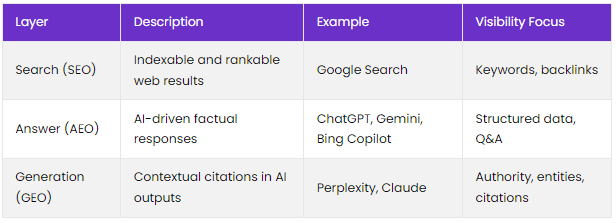
So marketers are not just optimising for search engines but also for answer engines and generative engines. This multi-layered approach is what agencies are calling Search Everywhere Optimisation, which refers to a strategy where visibility spans all discovery surfaces.
The rise of Generative AI search has definitely rewritten how brands compete for attention. But this change has also raised important questions, like whether traditional SEO is enough. Or is it time to expand the playbook beyond SEO?
Can SEO Remain the Core Foundation for Brands?
Search engine optimisation (SEO) is still the bedrock of online visibility – why? Well! The first reason is that traditional search engines, especially Google, are leading the search game despite the rising adoption of AI answer engines (ChatGPT, Claude, and others). Secondly, most of these platforms either directly use Google search results or use SerpAPI to scrape its results indirectly.
As long as this dependency exists, SEO will remain the core foundation for brands seeking online visibility, against GEO Vs. AEO. The former ensures that your site is easily crawlable, your content always stays relevant, and your brand has higher authority.
Without strong foundational SEO, AEO, and GEO strategies have little to build on. So here are some of the core SEO principles that will still matter in 2026:
- Keyword Research: Keywords identify what your audience searches for, and this element remains essential, with a slight deviation from the conventional approach. Long-tail and semantic keywords are now becoming the dominant mode, especially when integrating AI intent analysis.
- Link-Building & Topical Authority – Backlinks have always been an essential trust and authority signal. Their position didn’t change much even after answer engines entered the search ecosystem. High-quality backlinks still signal credibility to Google and AI systems as well because the latter rely on authority as a trust signal.
- Technical SEO – Site crawlability, structured markup, and performance metrics like Core Web Vitals remain prerequisites for any AI or search engine to index content effectively.
Key Takeaway: These SEO principles are evergreen. But that doesn’t mean the strategy by itself is static. It has evolved too!
What are the evolving SEO practices for 2026
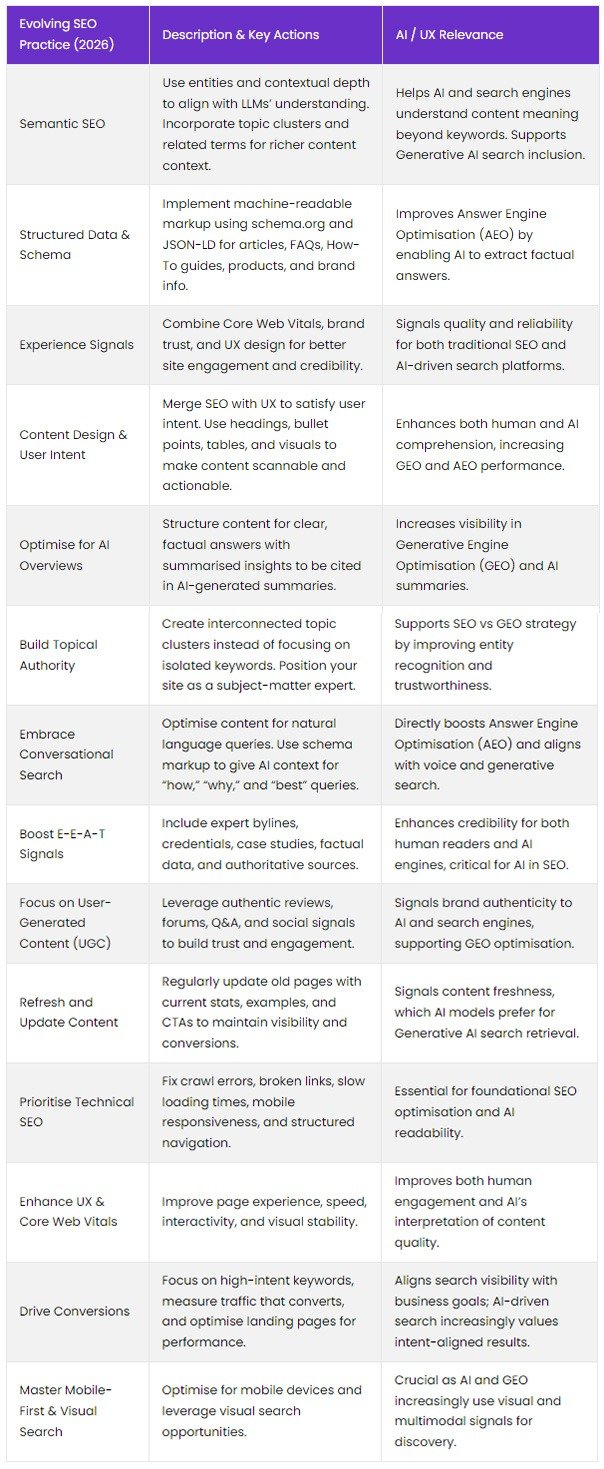
In 2026, SEO as a visibility strategy will be more about contextual completeness than ranking and traffic. Here’s a detailed overview of the SEO best practices to be followed in 2026:| Evolving SEO Practice (2026) | Description & Key Actions | AI / UX Relevance |
| Semantic SEO | Use entities and contextual depth to align with LLMs’ understanding. Incorporate topic clusters and related terms for richer content context. | Helps AI and search engines understand content meaning beyond keywords. Supports Generative AI search inclusion. |
| Structured Data & Schema | Implement machine-readable markup using schema.org and JSON-LD for articles, FAQs, How-To guides, products, and brand info. | Improves Answer Engine Optimisation (AEO) by enabling AI to extract factual answers. |
| Experience Signals | Combine Core Web Vitals, brand trust, and UX design for better site engagement and credibility. | Signals quality and reliability for both traditional SEO and AI-driven search platforms. |
| Content Design & User Intent | Merge SEO with UX to satisfy user intent. Use headings, bullet points, tables, and visuals to make content scannable and actionable. | Enhances both human and AI comprehension, increasing GEO and AEO performance. |
| Optimise for AI Overviews | Structure content for clear, factual answers with summarised insights to be cited in AI-generated summaries. | Increases visibility in Generative Engine Optimisation (GEO) and AI summaries. |
| Build Topical Authority | Create interconnected topic clusters instead of focusing on isolated keywords. Position your site as a subject-matter expert. | Supports SEO vs GEO strategy by improving entity recognition and trustworthiness. |
| Embrace Conversational Search | Optimise content for natural language queries. Use schema markup to give AI context for “how,” “why,” and “best” queries. | Directly boosts Answer Engine Optimisation (AEO) and aligns with voice and generative search. |
| Boost E-E-A-T Signals | Include expert bylines, credentials, case studies, factual data, and authoritative sources. | Enhances credibility for both human readers and AI engines, critical for AI in SEO. |
| Focus on User-Generated Content (UGC) | Leverage authentic reviews, forums, Q&A, and social signals to build trust and engagement. | Signals brand authenticity to AI and search engines, supporting GEO optimisation. |
| Refresh and Update Content | Regularly update old pages with current stats, examples, and CTAs to maintain visibility and conversions. | Signals content freshness, which AI models prefer for Generative AI search retrieval. |
| Prioritise Technical SEO | Fix crawl errors, broken links, slow loading times, mobile responsiveness, and structured navigation. | Essential for foundational SEO optimisation and AI readability. |
| Enhance UX & Core Web Vitals | Improve page experience, speed, interactivity, and visual stability. | Improves both human engagement and AI’s interpretation of content quality. |
| Drive Conversions | Focus on high-intent keywords, measure traffic that converts, and optimise landing pages for performance. | Aligns search visibility with business goals; AI-driven search increasingly values intent-aligned results. |
| Master Mobile-First & Visual Search | Optimise for mobile devices and leverage visual search opportunities. | Crucial as AI and GEO increasingly use visual and multimodal signals for discovery. |
Advantages vs. Limitations of Traditional SEO
SEO has essentially been the cornerstone of digital marketing for decades. But it is wearing a new hat, being under the influence of AI technology. Knowing the existing strengths and limitations from the new search ecosystem standpoint can help brands like yours decide how to complement traditional SEO with emerging strategies like AEO and GEO.| Aspect | Advantages of SEO | Limitations of SEO |
| Organic Visibility | Builds long-term discoverability on search engines, helping brands appear in relevant SERPs. | Alone, it cannot guarantee inclusion in AI-driven answers or generative summaries. |
| Cost Efficiency | Once content ranks, traffic can be sustained without continuous ad spend. | Competitive niches may require significant resources for keyword targeting and link-building. |
| Authority & Trust | Establishes brand credibility through backlinks, topical authority, and structured content. | AI models increasingly prioritise trust signals beyond traditional backlinks, like citations and entity recognition. |
| Traffic Quality | Captures query-driven, intent-aligned traffic for relevant products or services. | Traffic volume doesn’t always equate to conversions; may not align with search everywhere optimisation goals. |
| Analytics & Measurement | Provides clear KPIs like impressions, CTR, and organic conversions. | Metrics are limited to traditional search; does not fully measure AI visibility, answer presence, or GEO optimisation. |
| Adaptability | Can incorporate semantic SEO, structured data, and content clusters for evolving search trends. | Adapting to AI-first platforms requires additional strategies (AEO and GEO), which SEO alone doesn’t cover. |
| Content Longevity | Well-optimised pages can retain ranking and relevance over months or years. | AI-driven answers often prioritise fresh, concise, and contextually cited content, which older SEO content may not satisfy. |
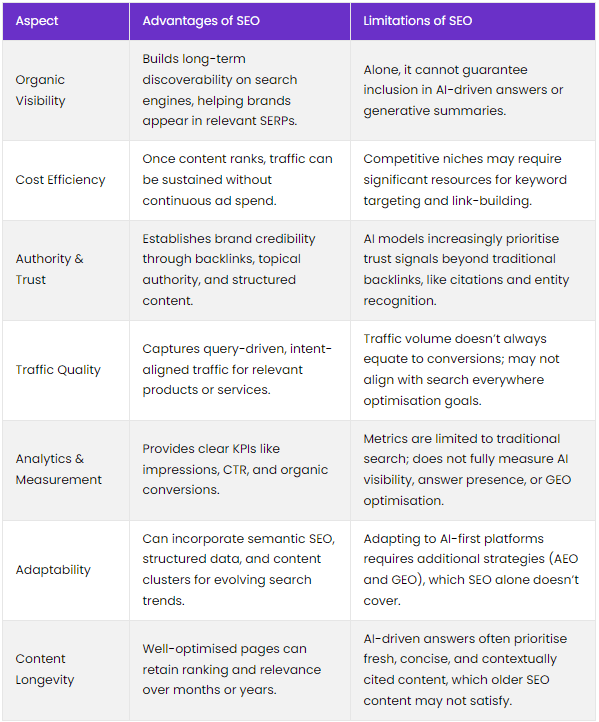
Key Takeaway: SEO still remains the ultimate go-to strategy for brands seeking long-term organic visibility, authority, and structured traffic. That said, it has now developed boundaries under the influence of AI-driven discovery and real-time answer retrieval.
How Answer Engine Optimisation Works
Ideally, the optimisation strategy for answer engines, including ChatGPT and Claude, is renamed as Answer Engine Optimisation, or AEO. It is the next step in the evolutionary trajectory of traditional SEO. Unlike SEO, which primarily focuses on rankings and traffic, the AEO strategy makes your content answer-ready for AI platforms, chatbots, and voice assistants. It targets conversational intent, addressing queries beginning with How, Why, What, and Best.
This ensures that your brand appears in AI-generated responses, zero-click search results, and knowledge panels, making your content discoverable even when users don’t click through to your website. AEO builds immediate visibility and trust in AI-driven environments.
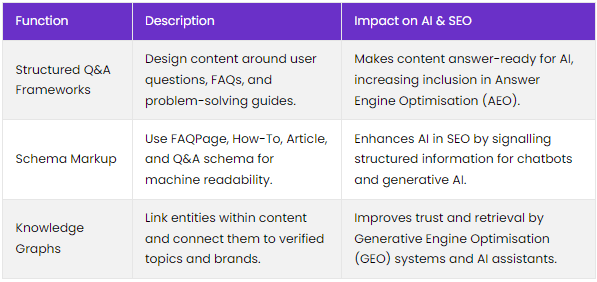
For AEO optimisation to perform, content needs to be structured as per AI search algorithms to extract factual, concise answers. Structured frameworks, schema markup, and entity linking are critical. AI models like ChatGPT, Gemini, and Claude rely heavily on these structures to include your content in summaries, PAA sections, and AI-generated answers.
| Function | Description | Impact on AI & SEO |
| Structured Q&A Frameworks | Design content around user questions, FAQs, and problem-solving guides. | Makes content answer-ready for AI, increasing inclusion in Answer Engine Optimisation (AEO). |
| Schema Markup | Use FAQPage, How-To, Article, and Q&A schema for machine readability. | Enhances AI in SEO by signalling structured information for chatbots and generative AI. |
| Knowledge Graphs | Link entities within content and connect them to verified topics and brands. | Improves trust and retrieval by Generative Engine Optimisation (GEO) systems and AI assistants. |
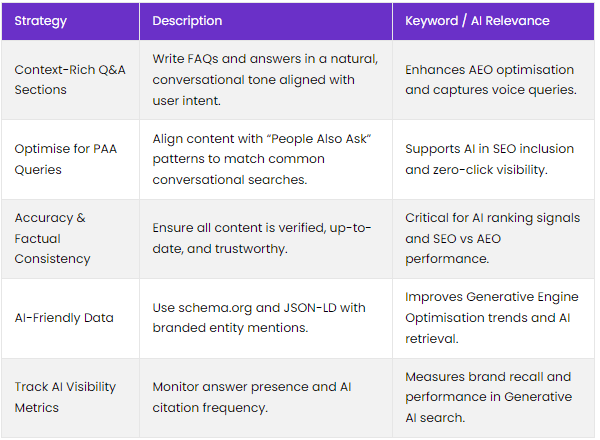
New AEO Optimisation Strategies for 2026
AEO optimisation strategy in 2026 will focus more on context-rich, AI-friendly content to satisfy conversational queries while building brand authority. Since generative AI has become an integral part of these answer engines/chatbots, integrating structured data, tracking AI visibility, and maintaining accuracy are essential for brands to stay competitive in the coming days.
Here’s a brief overview of how your AEO optimisation strategy will look in the future:
| Strategy | Description | Keyword / AI Relevance |
| Context-Rich Q&A Sections | Write FAQs and answers in a natural, conversational tone aligned with user intent. | Enhances AEO optimisation and captures voice queries. |
| Optimise for PAA Queries | Align content with “People Also Ask” patterns to match common conversational searches. | Supports AI in SEO inclusion and zero-click visibility. |
| Accuracy & Factual Consistency | Ensure all content is verified, up-to-date, and trustworthy. | Critical for AI ranking signals and SEO vs AEO performance. |
| AI-Friendly Data | Use schema.org and JSON-LD with branded entity mentions. | Improves Generative Engine Optimisation trends and AI retrieval. |
| Track AI Visibility Metrics | Monitor answer presence and AI citation frequency. | Measures brand recall and performance in Generative AI search. |
Common AEO Metrics to Measure Your Brand’s Performance
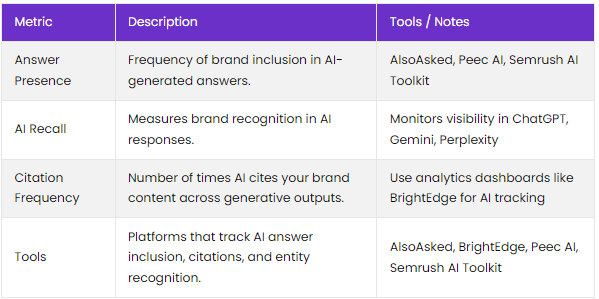
For traditional SEO, rank, CTR, and traffic were some of the key metrics for measurement. For AEO, measuring answer presence, brand recall, and citations across AI-driven platforms becomes a more dominant metric. Tracking them will help brands understand their visibility in AI ecosystems.
| Metric | Description | Tools / Notes |
| Answer Presence | Frequency of brand inclusion in AI-generated answers. | AlsoAsked, Peec AI, Semrush AI Toolkit |
| AI Recall | Measures brand recognition in AI responses. | Monitors visibility in ChatGPT, Gemini, Perplexity |
| Citation Frequency | Number of times AI cites your brand content across generative outputs. | Use analytics dashboards like BrightEdge for AI tracking |
| Tools | Platforms that track AI answer inclusion, citations, and entity recognition. | AlsoAsked, BrightEdge, Peec AI, Semrush AI Toolkit |
SEO vs. AEO – Which is Better?
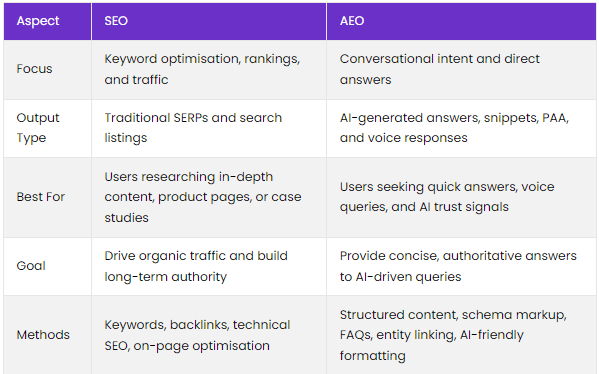
If you think AEO is inherently better than SEO, then you are slightly mistaken. Also, AEO mustn’t be seen as a replacement, but rather a complementary strategy to SEO. While the latter ensures high rankings and organic traffic, the former captures users seeking instant answers via AI, voice assistants, or zero-click search.
When you integrate both SEO and AEO into your brand-building strategy, you are covering the entire user journey at a go, right from initial query to in-depth research.
| Aspect | SEO | AEO |
| Focus | Keyword optimisation, rankings, and traffic | Conversational intent and direct answers |
| Output Type | Traditional SERPs and search listings | AI-generated answers, snippets, PAA, and voice responses |
| Best For | Users researching in-depth content, product pages, or case studies | Users seeking quick answers, voice queries, and AI trust signals |
| Goal | Drive organic traffic and build long-term authority | Provide concise, authoritative answers to AI-driven queries |
| Methods | Keywords, backlinks, technical SEO, on-page optimisation | Structured content, schema markup, FAQs, entity linking, AI-friendly formatting |
Key Takeaway: Balancing SEO and AEO ensures brands capture both deep engagement traffic and AI-first visibility, meeting users wherever they search, be it through traditional engines or Generative AI search platforms. For 2026, the most successful brands adopt a hybrid SEO + AEO strategy to maximise reach and authority.
How Is GEO Different from AEO
Generative Engine Optimisation, or GEO, represents the latest stage in the evolutionary history, which is beyond SEO and AEO. As the name suggests, GEO means optimising your brand for increased visibility in generative search engines.
On one hand, you have AEO that requires changes in your website content so that they can be used as answers in AI and voice search. On the other hand, you have GEO as a strategy that ensures your brand becomes retrievable, cited, and trusted within large language models (LLMs). Simply put, GEO entails rephrasing content in a way that appears as AI summaries, overviews, and chat-based responses.
GEO prioritises semantic clarity, factual reliability, and brand authority. This ensures that AI recognises your content as credible and not just readable.
How Does GEO Work Compared to AEO and SEO
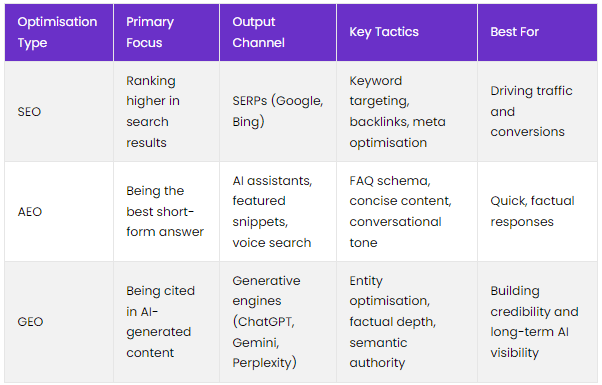
GEO differs fundamentally from SEO and AEO in its end-goal. While SEO optimises for rankings, and AEO for answers, GEO optimises for citations within generative models. It’s not about where you rank, but how often AI systems trust and use your content in synthesised responses.
Let’s take a look at the key differences existing between the three:
| Optimisation Type | Primary Focus | Output Channel | Key Tactics | Best For |
| SEO | Ranking higher in search results | SERPs (Google, Bing) | Keyword targeting, backlinks, meta optimisation | Driving traffic and conversions |
| AEO | Being the best short-form answer | AI assistants, featured snippets, voice search | FAQ schema, concise content, conversational tone | Quick, factual responses |
| GEO | Being cited in AI-generated content | Generative engines (ChatGPT, Gemini, Perplexity) | Entity optimisation, factual depth, semantic authority | Building credibility and long-term AI visibility |
Key Takeaway: GEO focuses on influence over ranking. It builds AI-trust visibility that ensures your brand is referenced every time, even when users do not click a search result.
GEO Optimisation Strategies for 2026
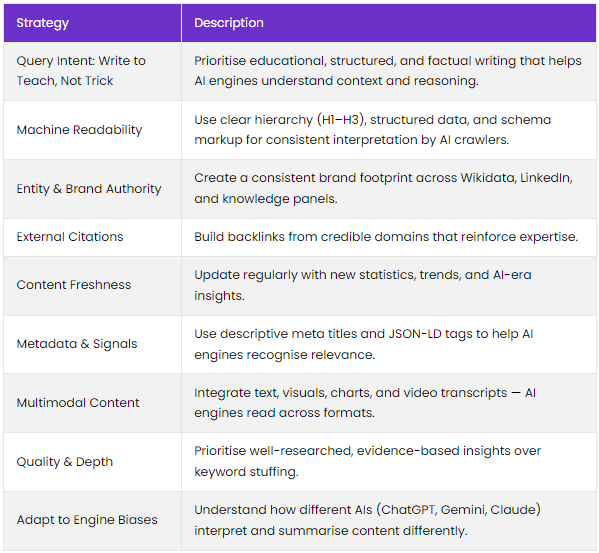
In 2026, GEO will dominate how brands appear in AI-driven search environments. Based on Madhav Mistry’s 10 Pillars of GEO, here is a sample framework for optimising content that generative AI engines will be able to read and rely on for answering search queries.| Strategy | Description |
| Query Intent: Write to Teach, Not Trick | Prioritise educational, structured, and factual writing that helps AI engines understand context and reasoning. |
| Machine Readability | Use clear hierarchy (H1–H3), structured data, and schema markup for consistent interpretation by AI crawlers. |
| Entity & Brand Authority | Create a consistent brand footprint across Wikidata, LinkedIn, and knowledge panels. |
| External Citations | Build backlinks from credible domains that reinforce expertise. |
| Content Freshness | Update regularly with new statistics, trends, and AI-era insights. |
| Metadata & Signals | Use descriptive meta titles and JSON-LD tags to help AI engines recognise relevance. |
| Multimodal Content | Integrate text, visuals, charts, and video transcripts — AI engines read across formats. |
| Quality & Depth | Prioritise well-researched, evidence-based insights over keyword stuffing. |
| Adapt to Engine Biases | Understand how different AIs (ChatGPT, Gemini, Claude) interpret and summarise content differently. |
Are There Any GEO Metrics to Measure?
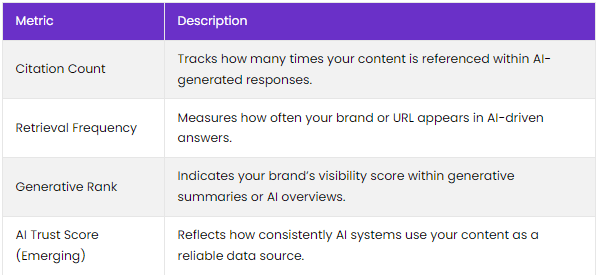
GEO introduces new success benchmarks focused on AI inclusion and visibility, not traditional rankings. The following metrics will help you to evaluate how often your content is retrieved or cited by LLMs, like ChatGPT and Gemini.| Metric | Description |
| Citation Count | Tracks how many times your content is referenced within AI-generated responses. |
| Retrieval Frequency | Measures how often your brand or URL appears in AI-driven answers. |
| Generative Rank | Indicates your brand’s visibility score within generative summaries or AI overviews. |
| AI Trust Score (Emerging) | Reflects how consistently AI systems use your content as a reliable data source. |
SEO vs. GEO vs. AEO – Key Differences
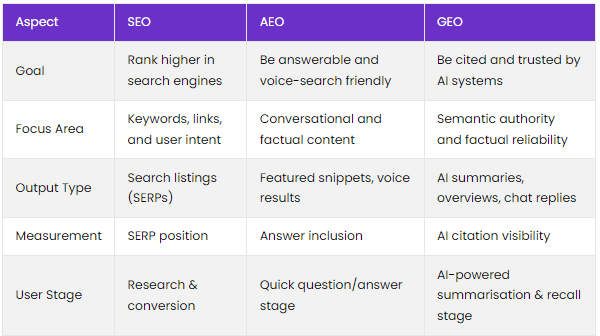
These three pillars of search optimisation coexist in the modern AI ecosystem. Each serves a unique role in the user’s discovery journey.
| Aspect | SEO | AEO | GEO |
| Goal | Rank higher in search engines | Be answerable and voice-search friendly | Be cited and trusted by AI systems |
| Focus Area | Keywords, links, and user intent | Conversational and factual content | Semantic authority and factual reliability |
| Output Type | Search listings (SERPs) | Featured snippets, voice results | AI summaries, overviews, chat replies |
| Measurement | SERP position | Answer inclusion | AI citation visibility |
| User Stage | Research & conversion | Quick question/answer stage | AI-powered summarisation & recall stage |
Why the Future of Discoverability Is a Convergence of SEO, AEO & GEO
The era of search is evolving beyond keywords and rankings. In fact, it has moved into multi-layered discoverability, which AI powers. Now, online visibility isn’t just about appearing on Google’s first page. It’s about being found, understood, and trusted by both humans and machines.
This is where SEO, AEO, and GEO converge. Each discipline covers a different stage of the user journey, right from visibility to answers and, finally, to AI memory. Together, they form a three-dimensional visibility model for the generative era.
| Optimisation Layer | Core Purpose | Outcome |
| SEO (Search Engine Optimisation) | Keeps your brand visible and indexable in traditional search results. | Builds sustained organic traffic and keyword authority. |
| AEO (Answer Engine Optimisation) | Makes your content answer-ready for voice assistants and AI-powered snippets. | Positions your brand as the go-to source for direct, factual responses. |
| GEO (Generative Engine Optimisation) | Makes your brand retrievable and memorable to AI systems and LLMs. | Builds long-term visibility in AI-generated overviews, summaries, and responses. |
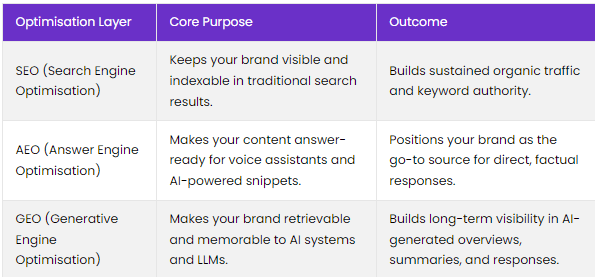
Key Takeaway: Together, these three layers ensure your brand isn’t just seen. It’s selected, cited, and trusted across all forms of digital discovery.
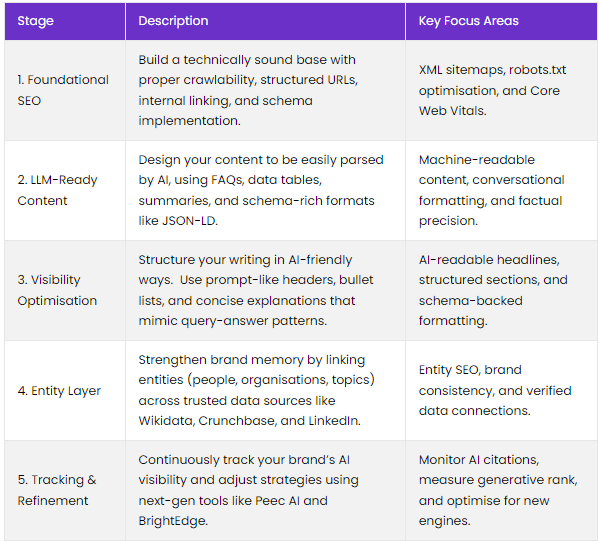
As AI search evolves, visibility depends on how well your brand is structured for both traditional crawlers and generative engines. Madhav Mistry’s 5-Stage LLM SEO Funnel provides a clear roadmap for integrating SEO, AEO, and GEO into one unified strategy.
| Stage | Description | Key Focus Areas |
| 1. Foundational SEO | Build a technically sound base with proper crawlability, structured URLs, internal linking, and schema implementation. | XML sitemaps, robots.txt optimisation, and Core Web Vitals. |
| 2. LLM-Ready Content | Design your content to be easily parsed by AI, using FAQs, data tables, summaries, and schema-rich formats like JSON-LD. | Machine-readable content, conversational formatting, and factual precision. |
| 3. Visibility Optimisation | Structure your writing in AI-friendly ways. Use prompt-like headers, bullet lists, and concise explanations that mimic query-answer patterns. | AI-readable headlines, structured sections, and schema-backed formatting. |
| 4. Entity Layer | Strengthen brand memory by linking entities (people, organisations, topics) across trusted data sources like Wikidata, Crunchbase, and LinkedIn. | Entity SEO, brand consistency, and verified data connections. |
| 5. Tracking & Refinement | Continuously track your brand’s AI visibility and adjust strategies using next-gen tools like Peec AI and BrightEdge. | Monitor AI citations, measure generative rank, and optimise for new engines. |
How Brands Can Prepare for 2026
As the boundaries between SEO, AEO, and GEO blur, the brands that succeed in 2026 will be those that optimise for AI-driven search ecosystems. Traditional SEO alone is no longer enough for marketers because they must adapt to how generative models retrieve, interpret, and cite information.
Here’s how your brand can evolve to stay discoverable, trustworthy, and AI-visible.
1. Audit Current SEO Setup
Start with the basics, like ensuring your website’s foundation is technically flawless and semantically structured. Fix crawl errors, implement schema markup, and maintain clean internal linking to help both search engines and AI models understand your site hierarchy.
Key Takeaway: This creates the groundwork for AEO and GEO readiness.
2. Map Conversational Intent
Analyse how users actually ask questions in your niche. Look beyond keywords to understand query intent and natural language phrasing. Build content around FAQs, “how-to” and “why” queries to align with conversational and voice-based search models.
Key Takeaway: This bridges traditional SEO with AEO.
3. Develop AI-Friendly Content
Structure your content for clarity and factual consistency. Use schema.org, JSON-LD, and entity linking to make your data readable by LLMs. Include context-rich summaries, tables, and citations because these elements will help increase your chances of being referenced by AI systems.
Key Takeaway: This step is key to GEO performance.
4. Monitor AI Visibility
Use LLM visibility tracking tools like Peec AI and BrightEdge to monitor where and how often your brand appears in AI-generated summaries or citations.
Key Takeaway: This replaces old ranking reports with new AI visibility metrics.
5. Invest in Continuous Learning
Train your content and SEO teams to master AEO analytics, GEO principles, and structured data strategies. Encourage experimentation with prompt engineering and AI-integrated SEO workflows.
Key Takeaway: In 2026, adaptability will be the most valuable optimisation skill.
Point to Remember: The future of discoverability isn’t linear. It has become multilayered. Brands that integrate SEO for visibility, AEO for relevance, and GEO for authority will dominate across search, voice, and generative ecosystems alike.
Conclusion
SEO vs GEO vs AEO isn’t just a debate anymore, and brands do not have to pick sides. Consider this more like a blueprint, where traditional SEO optimisation builds the base. On the other hand, GEO optimisation makes you discoverable, while AEO optimisation makes your content retrievable as answer summaries.
The three combine to form what we commonly call search everywhere optimisation. This means your brand doesn’t chase rankings, but creates visibility.
So now the question isn’t “Which one to focus on?” It’s about how fast your brand can adapt to all three.