Tl;DR
The rules of SEO are changing, but they are not disappearing. The new era rewards not simply “evergreen content” but evergreen + evolving content. If you can build your content engine according to the AI search’s recency bias, you’ll be better positioned to thrive, especially when AI-powered search engines become the default interface.
AI-powered retrieval and summarisation systems are constantly introducing new dynamics, and one of them being the recency bias.
This blog will walk you through the new concept, explain its relevance today in the context of AI search, and explain how it works.
What is Recency Bias in AI Search
The recency bias stems from the common tendency witnessed in humans, now replicated by AI systems, that overvalues newer information relative to older. One essential point noticed here is that this recency bias tends to ignore older content, even if the former appears more relevant or authoritative compared to the newer version. For AI-based search, this bias is altering the common factors initially responsible for surfacing, citing, or summarising content.
This concept was first brought to light by Metehan Yesilyurt. His article, “I Found It in the Code, Science Proved It in the Lab: The Recency Bias That’s Reshaping AI Search”, demonstrates the ‘how’ and ‘why’ behind the mentioned bias.
For marketers, content creators, and SEO professionals, this shift is far from academic. It demands rethinking long-standing assumptions, like the evergreen content will “just keep working,” or that “building domain authority over the years” is sufficient.
Point to Remember: In the era of generative AI, freshness increasingly competes with authority, and sometimes wins.
Key Takeaway: Trash every belief that you have had surrounding SEO and content ranking because none of that will work if your content is not recent or fresh in the eyes of AI.
Elucidating the Science Behind Recency Bias in AI Search
AI is biased, and this has been proven by several studies. Here are some of the findings to consider.
In the recent study, researchers tested whether injecting artificial publication dates into candidate passages would change how LLMs reorder them. Indeed, across seven different models, ranking shifts occurred. For example, the researchers tagged passages with newer dates and observed their systematic promotion compared to equally relevant but older passages. The study showed that those individual passages moved up by as many as 95 ranking positions purely due to the timestamp cue. Even larger models reduced, but did not eliminate, the effect.
This experiment isolates the timestamp as the variable, holding content constant. The results confirm that LLM-based re-ranking systems embed a recency preference in their logic. In other words, the “newness” signal is being treated as a proxy for relevance.
Further corroboration comes from anecdotal and practitioner observations. Metehan Yesilyurt discovered a configuration flag in ChatGPT’s internal settings, “use_freshness_scoring_profile: true”, which appears designed to amplify recency signals in re-ranking. Many case studies reinforce what many practitioners are seeing – older content, regardless of how authoritative they are, is slipping behind more recent, superficially updated articles.
Another compelling study looked at how AI “bot hits” (i.e., times AI systems visited content) correlates with content age. They examined over 5,000 URLs and found that ~65% of hits occurred on content published or updated within the past year; 94% of hits were on content updated within the past 5 years.
The pattern is clear: freshness is a dominant factor in AI systems’ attention.
Key Takeaway: These data sources suggest that recency bias is tangible, measurable, and already affecting AI search outcomes.
How AI Search Engines Decide Content Freshness
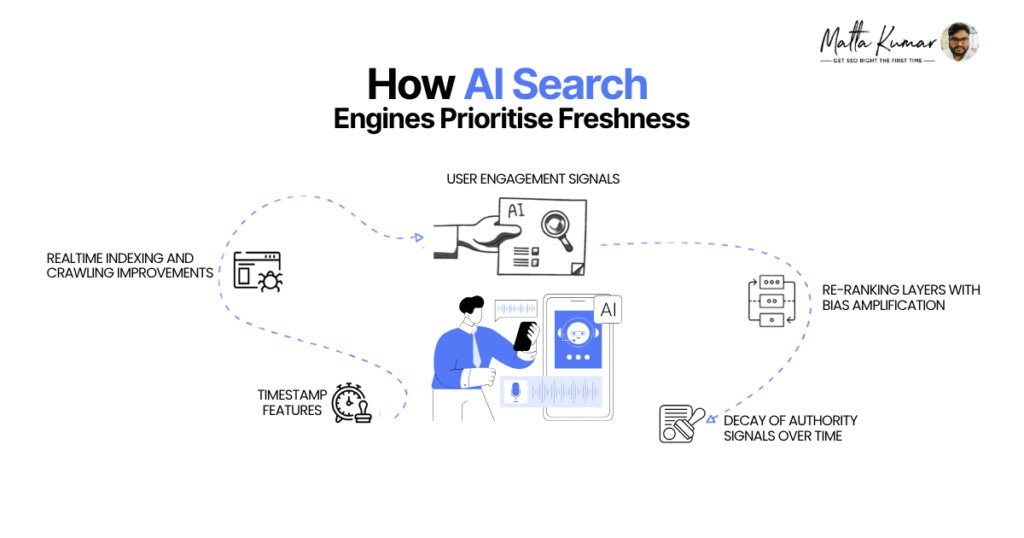
The most critical question now is – how does this bias emerge in the algorithms of AI search systems? Experts noticed several contributing mechanisms are at play, such as:
- Timestamp features: Traditional IR systems have long used publication dates, “last-modified” tags, or recency decay functions (e.g., favouring fresher content). Modern AI search systems often ingest or generate similar temporal metadata, which can feed into ranking or re-ranking layers.
- Realtime indexing and crawling improvements: AI-powered systems are increasingly capable of indexing and re-indexing content rapidly. This reduces crawling latency and enables fresh content to enter the candidate pool sooner.
- User engagement signals: Click-through rate, dwell time, bounce metrics – all of these user signals may be stronger (or more dynamic) for recent content. Newer articles tend to attract more traffic (mainly if they cover trending topics), which in turn reinforces their ranking via feedback loops.
- Re-ranking layers with bias amplification: Many systems use a multi-stage architecture: an initial retrieval (e.g., sparse or dense) followed by an LLM-based re-ranker that scores and reorders top candidates. If that re-ranker is tuned to favour recency, it can disproportionately elevate newer slices even when the baseline retrieval is less biased.
- Decay of authority signals over time: Signals like links, citations, or domain authority may weaken in influence over time. In contrast, freshness remains a constant signal that doesn’t degrade.
Key Takeaway: Because these mechanisms are deeply baked into the AI stack logic, the recency effect is structural, not merely anecdotal.
What Recency Bias Means for Your SEO Strategy
If recency bias is now part of the AI search landscape, how should SEO strategies evolve?
To answer the question, let’s explore the tactics mentioned below, which will help you to work with this new reality.
1. Refreshing Existing Content
Your most immediate lever is content maintenance and refreshing. This is how you can do:
- Update statistics, examples, and links regularly: Don’t just change the “last updated” date. You have to revise substantive content. Refresh data points, add recent case studies or references, and replace outdated or broken links.
- Re-optimise headlines and metadata: A refreshed title tag, an illustrative excerpt, or reworked meta description can signal renewed relevance, especially when aligned with current trends.
- Add new sections or insights to evergreen posts: Don’t stop at a superficial edit if you can expand the post by adding “2025 update,” comparisons, user Q&A, or new tools that send stronger signals of relevance.
- Use explicit update annotations: For transparency, do not forget to mention both the dates (original publication and the latest update date). This helps human readers and can also assist AI systems that parse structured metadata.
Key Takeaway: When you prioritise content refresh over creating new posts, your feed remains fresh continuously without diluting topical authority.
2. Agile Publishing and Timely Topics
Recency bias in AI also rewards reactive, trend-driven content. Here’s our takeaway on agile publishing:
- Create content around trending news or seasonal events: Leverage current developments in your industry. AI systems often favour content that aligns with what’s imminent or newsworthy.
- Use editorial calendars for frequent updates: Plan mini-refreshes or content refresh cycles, for example, monthly, quarterly, or aligned with key industry cycles.
- Leverage social listening and emerging topics: Monitor your niche (via feeds, forums, tools) to spot early signals of interest. Publish or update content rapidly to capture attention.
- Publish micro-updates or commentary responses: If full articles take longer, publish short, timely responses or snippets (e.g., “2025 update: X change in regulation”) that can quickly capture a freshness advantage.
Point to Remember: Coupling agility with strategic planning can help your business to ride the freshness wave.
3. Balancing Freshness with Authority
Freshness is powerful, but authority still matters regardless. Especially in domains where credibility counts, your topical authority can truly drive some quick wins. A few pro tips are mentioned below:
- Maintain cornerstone content with periodic updates: Major pillar pages or evergreen resources should not be abandoned. Schedule regular overhauls to keep them current.
- Link newer posts to authoritative older ones: Use internal linking to funnel freshness equity toward foundational content. A newly published post can reference and strengthen older, deeper articles.
- Use schema markup and structured data: Where possible, use dateModified, datePublished, updateHistory, or versioning metadata in JSON-LD or schema.org markup to explicitly signal update chronology.
- Signal domain or author trust: Use author bios, credentials, and a link to authoritative sources, so that freshness is complemented by credibility.
- Blend content types: Mix fresh trending content with deep-dive evergreen pieces. The fresh content helps you stay visible, and the evergreen content builds long-term value.
Key Takeaway: Balance is the key here. So, avoid chasing trending topics because that will cost your business’s reputation.
AI’s Recency Effect – How to Measure the Impact
For a strategy to remain fresh and relevant, you need essential metrics to track and understand whether updates are paying off or not.
Below are mentioned a few such metrics, which you need to track religiously to ride the recency effect successfully:
- Organic traffic changes after updates: Compare traffic before and after content refreshes. A lift in sessions, users, or page views can validate that fresh content is being surfaced.
- Ranking fluctuations for refreshed vs untouched content: Track SERP positions (or AI citation rankings) for pages you update versus a control group you leave untouched.
- AI visibility metrics or “bot hits”: If you have logs or access to AI system calls (e.g., AI crawler, ChatGPT citations), monitor whether your refreshed content is being referenced more often. Studies show that AI bots disproportionately hit recent content.
- Engagement metrics (bounce rate, dwell time, and shares): Fresh content should contribute to improved engagement, such as lower bounce, longer time on page, more scroll depth, and social shares.
- Citations in generative AI responses: Where possible, monitor whether your content is being cited or summarised by AI systems (e.g., ChatGPT, Google AI Overviews, Perplexity). Growth in citations is a strong signal of visibility.
Key Takeaway: When you track these metrics over time, you can easily prioritise which content needs immediate attention. Also, knowing the returns on your efforts is equally insightful. It gives a direction that your team can follow moving ahead.
How to Keep Your Website Content Recent – Top Tools to Leverage
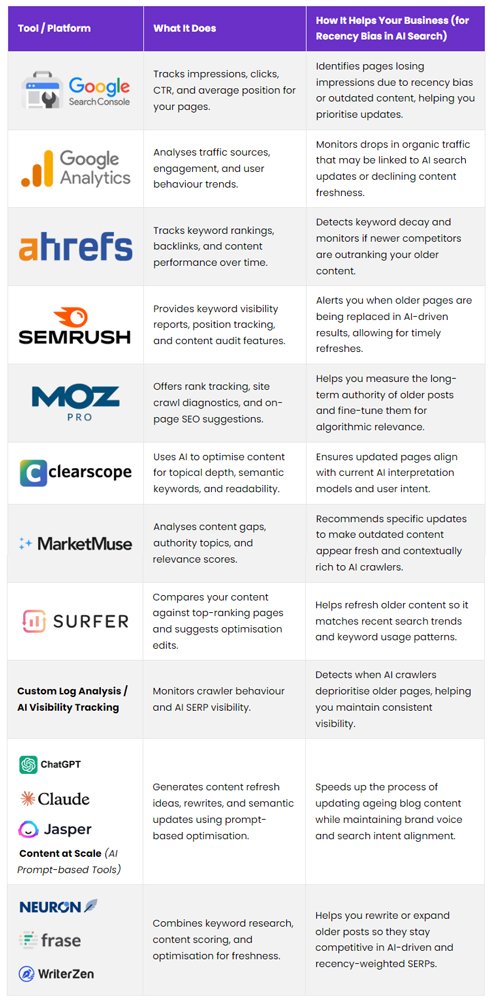
Staying relevant in an AI-driven search environment means continuously updating, auditing, and monitoring your content. With recency bias in AI search increasingly affecting rankings, the tools below can help you track visibility shifts, refresh older pages, and optimise content for ongoing performance.
| Tool / Platform | What It Does | How It Helps Your Business (for Recency Bias in AI Search) |
 | Tracks impressions, clicks, CTR, and average position for your pages. | Identifies pages losing impressions due to recency bias or outdated content, helping you prioritise updates. |
 | Analyses traffic sources, engagement, and user behaviour trends. | Monitors drops in organic traffic that may be linked to AI search updates or declining content freshness. |
 | Tracks keyword rankings, backlinks, and content performance over time. | Detects keyword decay and monitors if newer competitors are outranking your older content. |
 | Provides keyword visibility reports, position tracking, and content audit features. | Alerts you when older pages are being replaced in AI-driven results, allowing for timely refreshes. |
 | Offers rank tracking, site crawl diagnostics, and on-page SEO suggestions. | Helps you measure the long-term authority of older posts and fine-tune them for algorithmic relevance. |
 | Uses AI to optimise content for topical depth, semantic keywords, and readability. | Ensures updated pages align with current AI interpretation models and user intent. |
 | Analyses content gaps, authority topics, and relevance scores. | Recommends specific updates to make outdated content appear fresh and contextually rich to AI crawlers. |
 | Compares your content against top-ranking pages and suggests optimisation edits. | Helps refresh older content so it matches recent search trends and keyword usage patterns. |
| Custom Log Analysis / AI Visibility Tracking | Monitors crawler behaviour and AI SERP visibility. | Detects when AI crawlers deprioritise older pages, helping you maintain consistent visibility. |
   Content at Scale (AI Prompt-based Tools) Content at Scale (AI Prompt-based Tools) | Generates content refresh ideas, rewrites, and semantic updates using prompt-based optimisation. | Speeds up the process of updating ageing blog content while maintaining brand voice and search intent alignment. |
   | Combines keyword research, content scoring, and optimisation for freshness. | Helps you rewrite or expand older posts so they stay competitive in AI-driven and recency-weighted SERPs. |
Key Takeaway: Use them in concert to create a feedback loop: detect content decay, refresh, measure impact, iterate.
Are There Any Pitfalls to Avoid?
For any significant shift to happen, pitfalls, roadblocks, and trade-offs are necessary evils that follow. And the AI search’s recency bias effect has its fair share. Our suggestion is to stay informed about the following potential pitfalls so you can circumvent them successfully:
- Over-prioritising freshness at the expense of quality: Superficial edits or date changes can cost your content quality, especially if substantive content improvement is not taken care of. This approach may backfire, especially as AI models evolve.
- Ignoring technical SEO while chasing trends: Content freshness won’t save you if your content is not crawlable, indexed, or properly linked.
- Publishing too frequently without a clear strategy: Churning out low-value content just for freshness may reduce overall domain quality signals and user trust.
- Manipulating dates dishonestly: Using fake publication or update dates purely as an SEO hack is risky in the long term and may be penalised by AI systems as they improve their detection of superficial tactics.
- Failing to consider the query context: Some topics (history, classical philosophy, foundational theories) don’t benefit from recency tweaks. Freshness should be applied selectively, not uniformly.
- Resource constraints: Maintaining an extensive archive of content is expensive. Be strategic about which content to refresh vs retire or consolidate.
By working with discipline and ethics, you can reap fresh gains without undermining your content’s foundation.
The Future of AI Search – What It Means for Your SEO Strategy
It goes without saying that the recency bias we observe today is unlikely to be static. The situation will change sooner than you think. So here’s our understanding of where the future of AI search is heading, and how you can stay prepared.
- Evolving algorithms and nuance in temporal weighting: As AI models mature, they will likely become more discerning: valuing real updates more than superficial ones, distinguishing when recency matters (versus topics with permanent relevance).
- Personalisation and temporal context: Search systems may start tailoring freshness signals according to the user’s context (e.g., for breaking news versus evergreen topics).
- Integration of realtime data and live signals: AI search may increasingly ingest live signals (social media, realtime user behaviour) to adjust ranking dynamically.
- Content velocity as a ranking factor: The speed, frequency, and momentum of updates themselves may become a signal of authority or relevance.
How Can You Build a Resilient Content Ecosystem?
The recency effect is here to stay for a while. But in order to survive and thrive in this constantly shifting environment of AI search, you need a resilient content ecosystem.
Below are some helpful tips that you can also apply to your website and successfully ride any unforeseen changes:
- Mix content types (evergreen, trending, and reactive): Don’t put all your bets on freshness or novelty. Use each content class strategically.
- Strong internal linking and content clusters: Use link architecture to channel freshness signals into core content hubs.
- Implement team workflows for continuous optimisation: Assign ownership, schedule refresh cycles, and monitor decay. Treat content as a living asset, not a one-and-done project.
- Monitor AI visibility continuously: Routinely audit which of your pages are being cited or dropped by AI systems, and adapt accordingly.
- Experiment and learn: Run A/B tests: refresh vs no refresh, minor edits vs extensive rewrites. Document what works in your vertical.
- Defend against manipulation: Build content and update strategies rooted in quality, not date manipulation hacks.
Conclusion
Recency bias in AI search is not a fad; it is already reshaping which content surfaces, which pages get cited, and which voices dominate the generative AI ecosystem. As marketers and SEO professionals, we must adapt our mindset because freshness now competes directly with authority. Update cycles matter in AI SEO, and long-neglected content can slip into invisibility. This is the new normal, so adapt quickly and evolve faster than your competitors.
That said, the temptation to chase short-term gains with superficial edits or date manipulation is perilous. The stronger path lies in building content systems that maintain quality, stay current, and feed a cycle of measurement, refresh, and optimisation.