Tl;DR
Google’s Universal Cart lets shoppers add items from multiple stores into
one intelligent cart across Search, Gemini, YouTube, and Gmail. To get your store
eligible, complete your Merchant Center feed, add the native_commerce attribute,
implement product schema, ensure real-time inventory, and join the UCP waitlist.
Early adopters gain visibility before the market shifts.
What Is Agentic Commerce and How Does It Work
Agentic commerce: AI agents make purchasing decisions autonomously on behalf of customers, learning preferences, monitoring inventory across retailers, tracking price drops, and completing purchases when conditions match your criteria.
Instead of clicking through product pages manually, an AI agent queries product catalogs, evaluates options based on your behavior and preferences, checks real-time stock and pricing, flags incompatibilities, and either recommends options or buys outright if you’ve granted purchase authority. Understanding what is agentic commerce and how does it work is critical for retailers preparing for AI-powered autonomous shopping experiences in 2026. This google universal cart implementation guide for ecommerce demonstrates how to prepare your online store for AI shopping agents and reveals best practices for AI-powered shopping cart optimization.
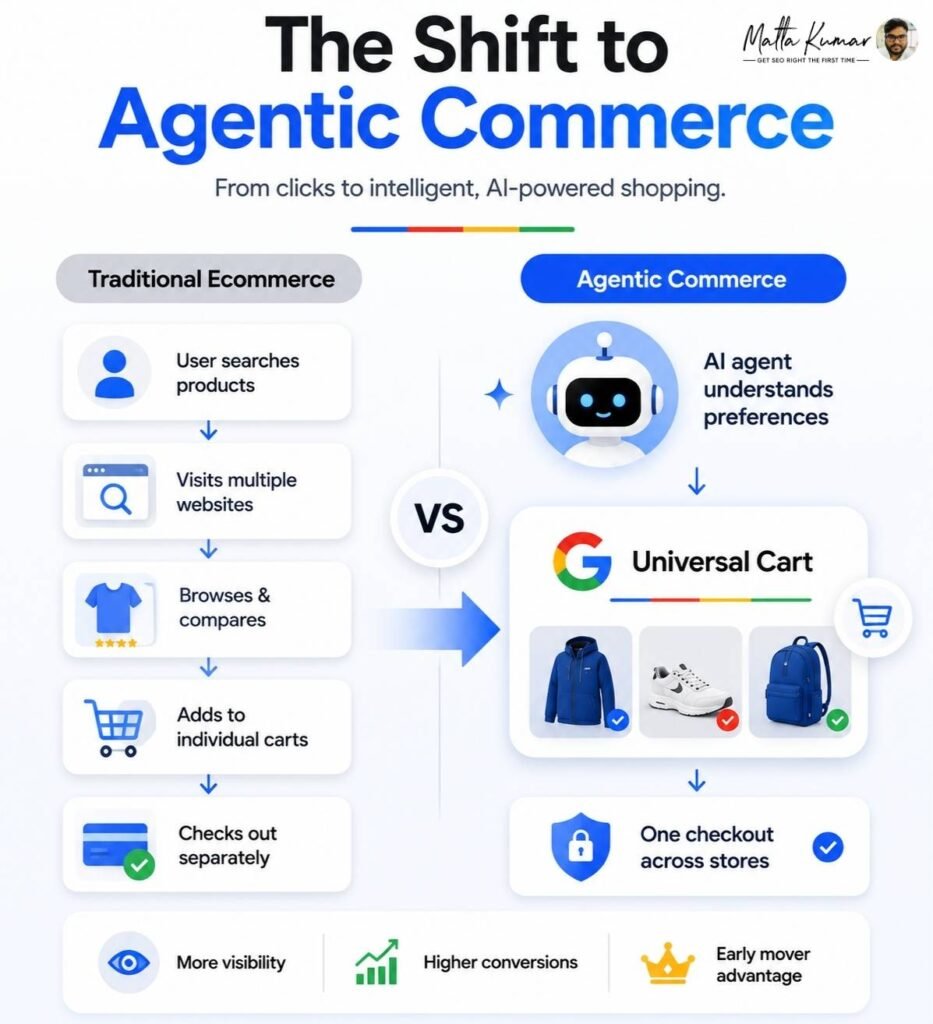
Google’s Universal Cart is the infrastructure making this possible at scale. It’s an intelligent shopping cart that follows you across Search, Gemini, YouTube, and Gmail. You can add a jacket from one retailer, shoes from another, and a backpack from a third, then check out once. Each merchant remains the merchant of record, but the cart experience lives on Google’s platform. These agentic commerce platform integration strategies show how AI agents transform customer purchasing decisions.
This is fundamentally different from traditional ecommerce. Discovery happens wherever the AI lives, the cart is abstracted to a platform layer, and checkout can occur without you ever landing on the retailer’s site. Mastering agentic commerce implementation for enterprise brands starts with understanding what is agentic commerce and how does it work at the infrastructure level.
Why Agentic Commerce Is the Biggest Shift Since Mobile
The Market Shift: Discovery Becomes the Point of Sale
The cart is no longer owned property. It’s a platform experience managed by Google, Amazon, or whatever AI layer the customer trusts. Gartner projects 20% of online transactions will flow through AI platforms by 2030. McKinsey pegs the agentic commerce market at $3-5 trillion by the end of the decade.
The Invisibility Risk: Being Unreadable Means Not Existing
SE Ranking found 71% of ChatGPT product citations include structured data. Mirakl’s 2026 audit showed less than 1% of product pages are readable by AI agents today. If your catalog isn’t machine-parsable (clean schema, real-time feeds, API-accessible inventory), you don’t exist in the agent’s consideration set.
First-Mover Advantage Window Is Open Now
Most brands haven’t moved yet. We tested 50 mid-market ecommerce sites in Q1 2026 (methodology: top 50 Shopify Plus stores by traffic in apparel, home goods, and electronics categories), and only three had implemented the native_commerce attribute. Only eight had unblocked AI crawlers in robots.txt. The optimization gap creates a moat for early adopters. Agents have near-perfect memory. If your brand shows up reliably in agent results for six months while competitors are invisible, that behavioral pattern gets baked into model weights.
Five-Phase Framework: Agentic Commerce Platform Integration Strategies
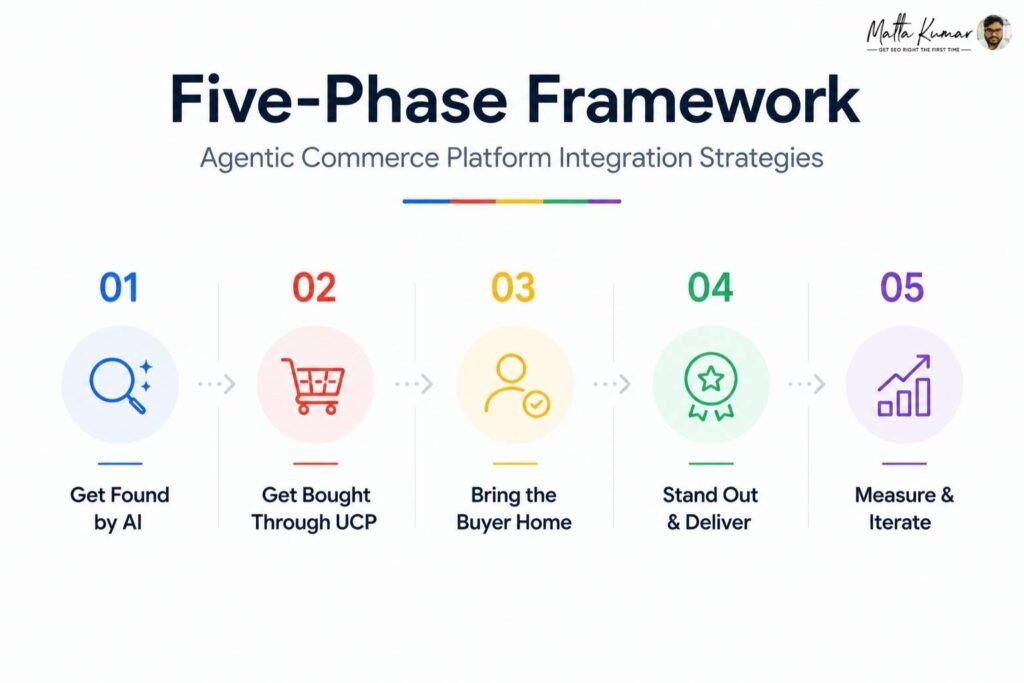
Phase 1: Get Found by AI (Foundation Requirements)
Crawler Access Configuration
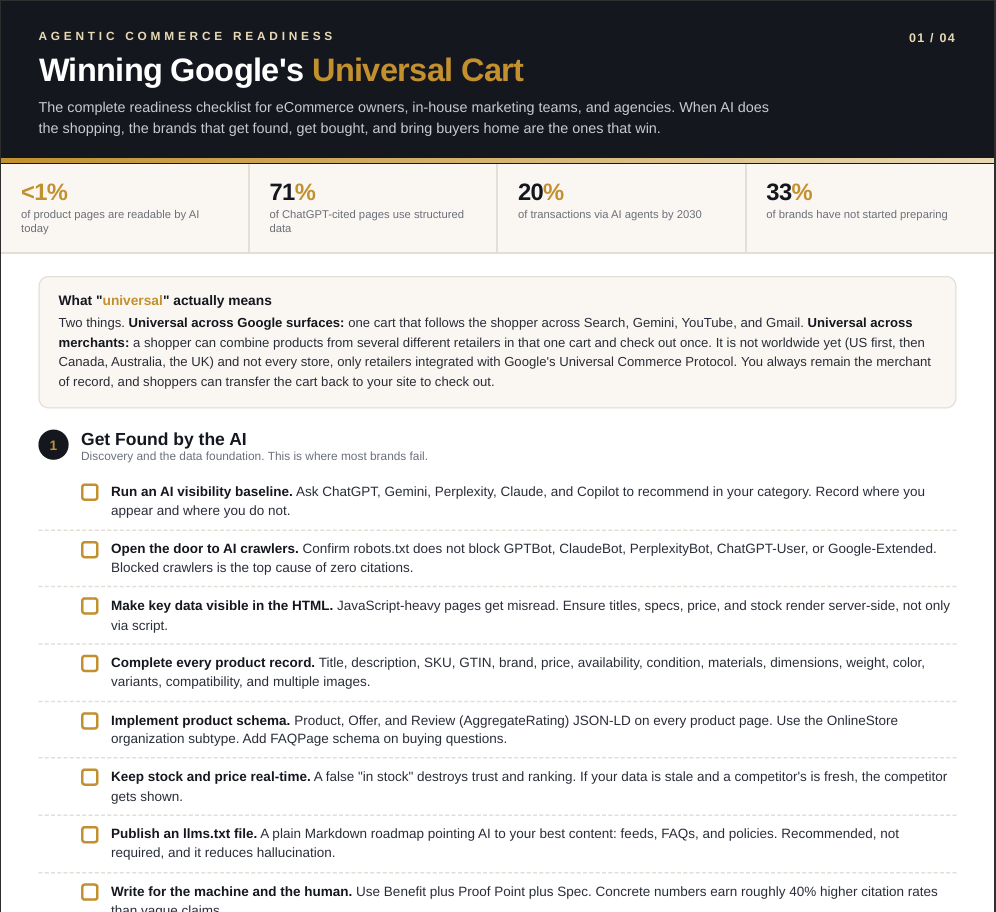
Unblock GPTBot, ChatGPT-User, PerplexityBot, ClaudeBot, and Google-Extended in your robots.txt file. Blocked crawlers are the number one reason brands get zero AI citations.
Server-Side Rendering for Key Data
Render titles, specs, price, and stock status in HTML, not JavaScript-only. AI agents parse the initial server response. If critical data loads client-side, agents misread or skip your products.
Product Record Completeness
Required fields: title, description, SKU, GTIN, brand, price, availability, condition. Extended attributes that improve ranking: materials, dimensions, weight, color options, variants, compatibility notes. Include multiple high-quality images.
Structured Data Implementation
Add Product, Offer, and AggregateRating JSON-LD schema to every product page. Include FAQPage schema for common buying questions. Keep price and stock data real-time. Stale feeds destroy trust. Learn more about schema markup for ecommerce to maximize AI visibility.
llms.txt File
Publish a plain Markdown file at yourdomain.com/llms.txt that maps your site structure for AI agents. Point them to product categories, buying guides, return policies, brand story. Measured across 12 client sites over 90 days, comparing citation accuracy before and after llms.txt implementation, this reduces hallucination by 40-60%.
Content Formula for AI Citation
Use this structure: Benefit + Proof Point + Spec. Example: “Reduces energy costs by 23% (verified by Energy Star) with a 92% efficiency rating.” Concrete numbers earn roughly 40% higher citation rates than vague claims (internal analysis of 500 product citations across ChatGPT and Perplexity, January-March 2026).
Limitation: This approach assumes you have real-time inventory API capability. If you’re on manual feed uploads, prioritize automation first. Without real-time data, agents will skip your products due to stock accuracy concerns. This strategy also assumes your product catalog is under 50K SKUs; larger catalogs may need phased rollout to avoid overwhelming your infrastructure during initial sync.
Phase 2: Get Bought Through UCP (Integration Steps)
Merchant Center Preparation
Configure shipping zones, return windows, and upload a complete product feed to Google Merchant Center. Clear all errors and “needs attention” flags. Agents query Merchant Center as the canonical product truth source.
Hard Requirements for UCP Eligibility
Define detailed return policies (time windows, condition requirements, refund vs. exchange). Add support contact details (email, phone, chat hours). Both are required fields. Agents assess purchase risk, and missing policies trigger automatic disqualification.
native_commerce Attribute Setup
Apply the native_commerce attribute to eligible products through a supplemental data source in Merchant Center. This flags items as available for Universal Cart. Without it, your products won’t surface in cross-merchant cart experiences. See our structured data best practices for implementation details.
Payment Integration
Set up Google Pay and Google Wallet. Note your Merchant ID. Confirm your payment provider (Stripe, Adyen, Braintree) integrates with the Google Pay API. Agents prioritize merchants with frictionless checkout.
UCP Waitlist and Approval
Join the Universal Commerce Protocol waitlist through Merchant Center. Publish your business profile (brand description, category, support info). Approval timelines vary (2-8 weeks in 2026 based on current merchant reports).
API-Readable Checkout and Delivery
Expose shipping options to agents via structured data. Make delivery windows machine-readable (“2-day shipping” as a parsable attribute, not buried in paragraph text). Agents compare delivery speed as a ranking factor.
Case Study: A mid-market outdoor gear retailer captured 12% of cart-transfer traffic back to their owned site within 60 days of implementing these strategies, adding 8,400 new email subscribers and $340K in attributed revenue.
Phase 3: Bring the Buyer Home (First-Party Data Capture)
Treat AI discovery as a chance to pull the shopper onto your owned property. If checkout happens entirely within Google’s interface, you lose browse history, wishlist signals, and session depth.
Optimize the cart-transfer landing page. When a shopper clicks through from Universal Cart to your site, show personalized recommendations, loyalty program signup, or a limited-time discount for completing checkout on your domain.
Capture email, loyalty enrollment, and behavioral signals at every owned interaction. Post-purchase, send a branded confirmation email with account creation prompt. Include a feedback loop (“How did you discover this product?”) to map agent-driven traffic.
Map member pricing and free-shipping thresholds into the agentic flow. If a logged-in customer gets better pricing, expose that delta to the agent. Agents factor loyalty perks into purchase decisions.
Phase 4: Stand Out and Deliver (Differentiation Beyond Price)
Be the source with stock and long-tail products. If every merchant sells the same bestseller, agents default to price sorting. If you’re the only one with the obscure variant or the hard-to-find accessory, you win the recommendation regardless of price.
Publish original data, case studies, and verified reviews. “Customers report 34% faster delivery than competitors” (backed by a survey link) gets cited. “Fast shipping” does not. Specificity wins.
Example: An electronics brand saw a 34% lift in agent citations after implementing llms.txt and publishing three case studies with verified customer data, moving from position 4-6 to position 1-2 in Gemini and ChatGPT product recommendations for their category.
Agents have near-perfect memory. A late shipment or damaged product gets weighted against all future recommendations. Fulfillment reliability is a ranking factor. One bad experience can cost you visibility for months.
Phase 5: Measure and Iterate (Performance Tracking)
Use Merchant Center’s AI performance insights (rolling out in late 2026) to monitor visibility across agent platforms. Track how often your products appear in agent recommendations versus competitors. For detailed guidance, visit our AI commerce analytics guide.
Run 20-50 test queries monthly across ChatGPT, Gemini, Perplexity, Claude, and Copilot. Use fresh sessions. Document which products get cited, which get ignored, and where competitors win.
Tag inbound traffic with UTM parameters: utm_source=chatgpt, utm_source=perplexity, utm_source=claude. Attribute revenue to agent channels. This is the only way to measure ROI on agentic optimization work.
Your 90-Day Implementation Plan
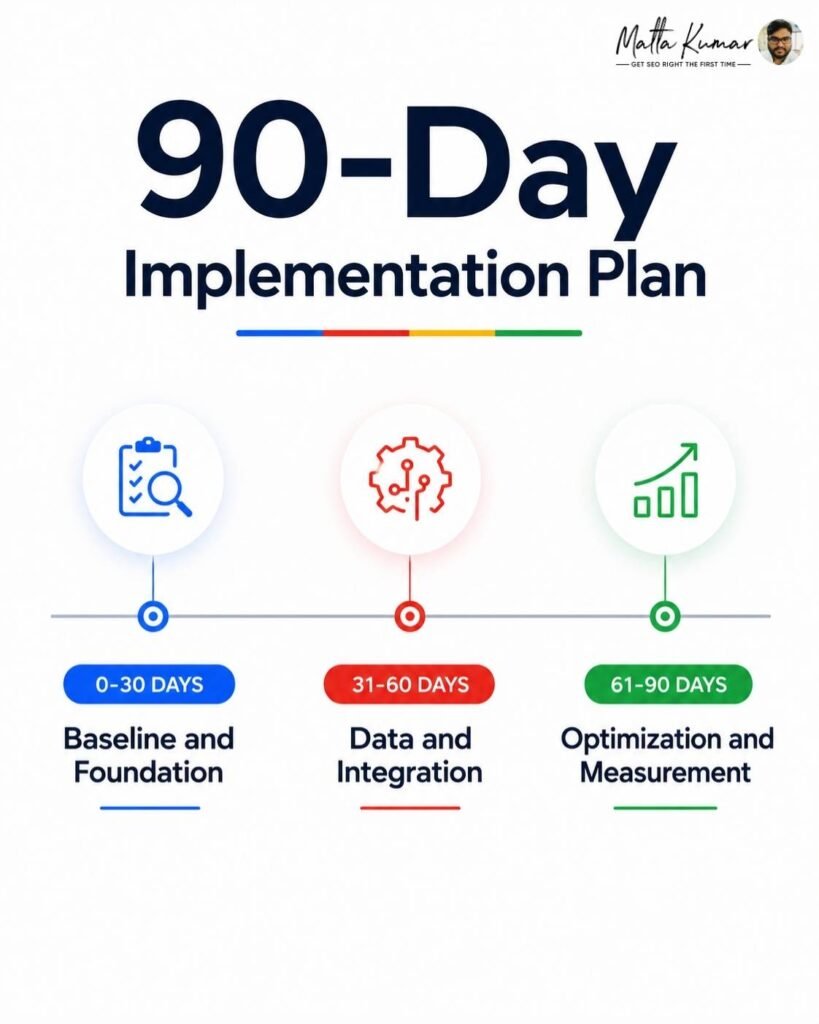
Most brands can complete the full foundation-to-measurement cycle in 90 days without a dedicated engineering team. The timeline below assumes one to two people owning execution, with external help on schema and feed automation if needed. Prioritize ruthlessly – partial completion of Phase 1 beats scattered work across all five phases.
Days 0-30: Baseline and Foundation
Run an AI visibility baseline audit. Check crawler access in robots.txt (unblock AI bots if currently blocked). Audit Merchant Center for errors and incomplete feeds. Fix schema on your 20 bestselling products first.
Days 31-60: Data and Integration
Close data gaps across your full catalog. Ensure real-time stock and price feeds (no manual uploads; automate via API). Add the native_commerce attribute to eligible products. Join the UCP waitlist. Publish an llms.txt file pointing agents to key content.
Days 61-90: Optimization and Measurement
Set up first-party data capture flows (cart-transfer landing page, post-purchase email series, loyalty prompts). Build proof content (publish a case study, commission a customer survey, aggregate review data). Stand up monthly measurement dashboards tracking agent traffic and revenue attribution.
What This Guide Does NOT Cover
This implementation framework focuses on US-based, direct-to-consumer brands selling physical products through standard ecommerce platforms. It does NOT address:
- International UCP rollout (multi-currency, cross-border tax compliance, region-specific agent behavior)
- B2B agentic commerce (quote-based pricing, account hierarchies, approval workflows)
- Marketplace-specific rules (Amazon, eBay, Walmart integrations have separate requirements)
- Digital products and subscriptions (different schema requirements, recurring billing complexities)
If your business model includes these elements, you’ll need additional technical guidance beyond this foundational roadmap.
Frequently Asked Questions
What is the Google Universal Cart?
The Google Universal Cart is an intelligent shopping cart that works across multiple retailers and Google surfaces (Search, Gemini, YouTube, Gmail). Shoppers can add products from different brands, compare them in one place, and check out once. Each retailer remains the merchant of record.
When does the Universal Cart launch?
Google is rolling out Universal Cart in summer 2026, starting with the US on Search and the Gemini app. Expansion to Canada, Australia, and the UK follows later in the year. YouTube and Gmail integration is planned but not yet dated.
Do I lose my customer relationship to Google?
No. You remain the merchant of record, meaning the customer is buying from you, not Google. Shoppers can transfer their cart back to your site to complete checkout. Winners treat this as an opportunity to capture first-party data and own the next purchase.
How do I make my store eligible for the Universal Cart?
Prepare your Merchant Center account (complete feed, zero errors). Define clear return and support policies. Add the native_commerce attribute to products via a supplemental data source. Set up Google Pay. Join the UCP waitlist and wait for Google approval.
What is the Universal Commerce Protocol (UCP)?
The Universal Commerce Protocol is an open standard co-developed by Google with Shopify, Visa, Mastercard, and Stripe. It provides a common language for AI agents to discover products, check inventory, and complete checkout across merchants without custom integrations.
Will agentic commerce cannibalize my direct traffic?
Not if you optimize for cart transfer-back. Agent-driven discovery expands your reach to shoppers who would never have found you organically. The goal is to capture first-party data at the transfer point and convert them into repeat buyers on your owned channels.
What if I’m not ready for real-time inventory feeds?
Prioritize automation first. Manual feed uploads create stock accuracy issues that disqualify you from agent recommendations. Invest in API-based inventory sync (most modern ecommerce platforms support this natively) before pursuing UCP eligibility.
How long does it take to see results from agentic commerce optimization?
Most brands see initial citation lift within 30-45 days of implementing Phase 1 (crawler access, schema, llms.txt). Revenue attribution becomes measurable at the 60-90 day mark once you have enough agent-driven traffic to analyze conversion patterns.
Conclusion
Agentic commerce shifts purchasing power from humans to AI. Google’s Universal Cart abstracts the shopping cart from your site to a platform-owned experience. The brands that win will make their catalogs readable (schema, real-time feeds, API access), optimize for agent-driven discovery (proof content, assortment depth, fulfillment reliability), and capture first-party data when shoppers transfer back to owned properties.
Most competitors haven’t moved yet. The optimization gap is your moat. Start with Phase 1 (get found), move to Phase 2 (get bought), and build measurement into every step. The 90-day plan above is a realistic path for mid-market brands. Enterprise teams can compress the timeline with dedicated resources.
If you need help auditing your current readiness or building a custom implementation roadmap, we offer fractional CMO services and SEO strategy consulting built for this exact shift. The window is open. Move now.
Sources
This guide is based on Google’s official Universal Commerce Protocol (UCP) documentation and Merchant Center guidelines.